
Live dispatch for Mietwagen fleets
Mietwagen dispatch software: your whole fleet in real time on one board
Dispatch software for a German Mietwagen fleet collects every job from Uber, Bolt and direct customers on one live board at your base. The dispatcher sends each job to a driver, sees which car is busy, returning or ready, and gets an alert when a car sits without a follow-up job after a trip – the case covered by the return-to-base rule in § 49(4) PBefG.
A Mietwagen is a hired car with driver under the German passenger transport act. Flottenlive is built for dispatchers of fleets with 21 to 50 cars: one screen instead of an Uber Fleet tab, a Bolt Fleet tab, the phone and a WhatsApp group.
Last updated: 15 November 2026
Incoming jobs 4 open
- #4821UberCentral station → Trade fair · in 9:46 pmNew – pick a driver
- #4820Direct customerPark hotel → Airport · pickup 10:30 pmSent to driver · Car 14
- #4819BoltOld town → South ring · in 9:41 pmAccepted · Car 07 (follow-up)
- #4818Business clientNorth office → Station · in 9:38 pmAccepted · Car 22
Cars 6 of 36
- Car 07busy, next job already assignedFollow-up
- Car 14job #4820 awaiting acceptanceSent
- Car 22on trip for 6 minBusy
- Car 03trip ended, no new jobReturning
- Car 18since 9:20 pmReady
- Car 31trip ended 9 min agoCheck
Alerts 3
- Return to baseCar 31: no follow-up job since trip endSend it back to base.
- Waiting#4821 not assigned yet9 cars ready at base.
- DeadlineCar 26: inspection due in 12 daysBook a slot.
In short: the rules a Mietwagen dispatcher works under
- Jobs are received only at the base (Betriebssitz) or the operator's home (§ 49(4) sentence 2 PBefG).
- Record each incoming job, in a book or electronically, app-based systems included, and keep it for one year (§ 49(4) sentence 4 PBefG).
- Return to base without delay after a trip, unless the car received a new job before the trip from the base or during the trip (§ 49(4) sentence 3 PBefG, the Rückkehrpflicht).
- Germany's Federal Court of Justice (BGH) upheld the rule on 3 June 2026 (I ZR 123/25, press release in German).
- Employee data on the board: follow § 26 BDSG (data protection) and involve the works council if you have one (§ 87(1) no. 6 BetrVG).
Definition
What is a live dispatch board for Mietwagen?
A live dispatch board is the dispatcher's main screen: the job queue on the left, every car and its status in the middle, and on the right the alerts that need a decision now. It replaces jumping between platform apps, the phone and a chat group.
For Mietwagen, the board has a second job. It is the place where a job is "received at the base", as German law requires. Every incoming job is stored with its time, which gives you the one-year record the passenger transport act asks for without keeping a separate order book.
The board is not a GPS tracking unit you fit into every car. It works with the trip data from your Uber Fleet and Bolt Fleet accounts and with the jobs you send yourself.
The five statuses on the board
- Received
- The job has reached your base and is waiting for a driver.
- Sent to driver
- The dispatcher has assigned it to a car; acceptance is pending.
- Busy
- The trip is running. A new job can already go out as a follow-up.
- Returning
- The trip has ended with no follow-up job: the car has to go back to base.
- Ready
- The car is at the base and can take the next job.
The problem
Why do dispatchers without a live view lose time and money?
Because jobs arrive in three places and none of them shows the whole fleet. Uber Fleet shows Uber trips, Bolt Fleet shows Bolt trips, and direct customers call or send a WhatsApp message. With 21 to 50 cars, "who is free right now?" means checking three windows and asking around, every time.
Empty kilometres you didn't need to drive
A follow-up job that reaches a car during its trip is allowed and saves the empty run back. Without an overview it goes to a car already waiting at base, and the other one drives back empty.
Return-to-base breaches that others spot first
In the BGH case, a Mietwagen waited about twelve minutes at Breslauer Platz in Cologne after a drop-off. A taxi cooperative sued for an injunction and won; the operator was held liable for its subcontractor's breach (BGH press release 100/2026).
A job record spread over five chats
Each incoming job must be recorded and kept for a year. When direct-customer jobs live on the dispatcher's phone, every query turns into a search.
| Cars on the evening shift | 35 |
|---|---|
| Follow-up jobs per car and shift, sent during the trip | 2 |
| Empty return saved per follow-up job | 7 km |
| Empty kilometres saved per shift | 490 km |
| Cost per km (example value) | $0.20 |
| Saving over 25 shifts a month | $2,450 |
Working: 35 × 2 × 7 km = 490 km; 490 km × $0.20 × 25 = $2,450. After setup, the dashboard shows your own cost per kilometre.
How a job moves
How does a job move across the board, from receipt to return?
In five steps, each visible on the board. The dispatcher always knows where a job stands and which car will be free next.
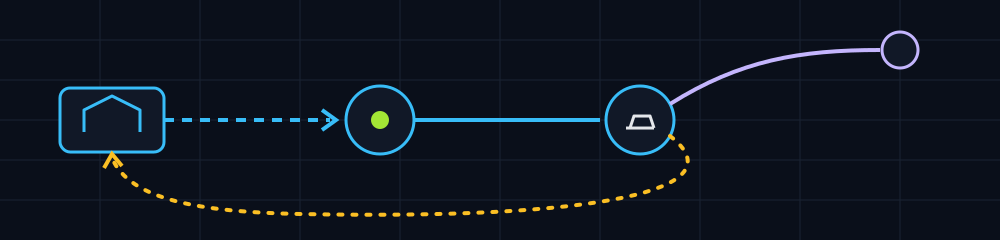
The job is received at the base
Uber and Bolt requests come in automatically; the dispatcher records direct-customer jobs. Each one is stored with its time.
Send it to a driver
The dispatcher picks a ready car, or one just finishing a trip, and forwards the job.
The trip runs
The car shows as "Busy". The board shows how many cars are out and which jobs are still open.
Send a follow-up – or return
If a suitable job is waiting, it goes to the car while the trip is still running. Otherwise the status switches to "Returning".
Return-to-base alert
If a car stays without a follow-up job after its trip, an alert appears on the board, before an inspection finds the case.
The law
What does § 49(4) PBefG require of Mietwagen dispatch?
In short: jobs are received at the base and recorded, and after every trip the car returns unless it has a new job. Each rule has a fixed place on the board.
| Rule | What it says | On the board |
|---|---|---|
| Sentence 2 | Only carry out jobs received at the base or the operator's home. | All jobs run through the base's job queue. |
| Sentence 3 | Return without delay after the trip, unless a new job came in before the trip (from base or home) or during the trip. | "Returning" status, follow-up jobs, alert for cars without a follow-up. |
| Sentence 4 | Record receipt in a book or electronically (app-based included), keep for one year. | Every incoming job stored with its time. |
| Sentence 5 | Accepting, brokering, standing by and advertising must not cause confusion with taxis. | Cars wait at the base, not at the kerb. |
Source: § 49 PBefG on gesetze-im-internet.de (German), checked 15 November 2026.
BGH ruling of 3 June 2026 – I ZR 123/25
Germany's Federal Court of Justice held that the return-to-base rule is not measured against EU law where a case has no cross-border element, and it had no serious doubts about its constitutionality. The Mietwagen operator's appeal failed.
For dispatchers this means the rule still applies, and a subcontractor's breach comes back to the operator who gave the job. Read press release no. 100/2026 (German)
Vehicle tracking and data protection
GPS tracker or live board: what does a dispatcher actually need?
Dispatch runs on job status, not on a dot on a map. A GPS tracker shows where a car is; the live board shows which car has which job and which one is free.
| Question | GPS tracker in the car | Live dispatch board |
|---|---|---|
| Data source | A device fitted to every car | Trip data from Uber Fleet and Bolt Fleet, your own jobs |
| Send jobs to drivers | No | Yes, including follow-ups during a trip |
| Record job receipt under § 49 PBefG | No | Yes, with time |
| Return-to-base alert | No | Yes, for cars without a follow-up job |
| Uber, Bolt and direct customers in one view | No | Yes |
Data protection: § 26 BDSG
You may process your employed drivers' data where it is necessary to carry out the employment relationship, following the principles of Art. 5 GDPR such as purpose limitation and data minimisation (§ 26(1) and (5) BDSG, German Federal Data Protection Act). Define what the board is used for: dispatch and compliance with the return-to-base rule.
Works council: § 87(1) no. 6 BetrVG
If your business has a works council (Betriebsrat), it has a right of co-determination over introducing and using technical systems designed to monitor employees' behaviour or performance (§ 87(1) no. 6 BetrVG, Works Constitution Act). Involve it before you start, ideally with a works agreement.
The solution
Which modules sit behind the live board?
Four modules work together on the board, chosen for a dispatcher's day rather than for accounting.
Forward jobs to drivers
Uber and Bolt requests and your direct customers' jobs land in one queue and go to the right driver in one click, including as a follow-up during a trip.
Watch the return-to-base rule
Cars without a follow-up job after a trip show up as an alert, so you see a breach before a BOKraft inspection (the operating rules for passenger transport) or a competitor does.
Every car's deadlines
Vehicle inspection (TÜV/HU), insurance and Konzession (operating licence): the board warns before dates run out, so no car drops out of the evening shift.
Keep direct customers
Hotels, companies and regulars with their trips in one place. Direct customers pay better and make you less dependent on Uber and Bolt.
Setup
How fast is the live board up and running?
In about 48 hours, in three steps. The dashboard then also shows revenue per driver and per car, cost per kilometre and upcoming deadlines.
Upload cars and drivers
Upload your vehicle list and driver list once so every car appears by name on the board.
Connect Uber Fleet and Bolt Fleet
Link the fleet accounts. From then on, platform trips flow onto the board automatically.
Start dispatching
Record direct-customer jobs and send them to drivers. Try it free for two days, no credit card.
In use
Who already works this way?
More than 700 taxi and Mietwagen operators use the software behind Flottenlive. Three results from practice:
Timesheet work: about 5 hours a week before, under 1 hour a month after.
found that was losing a few hundred euros every month, visible only once profit was tracked per vehicle.
uncovered by matching dashcam data against drivers' online status on Uber.
Price
What does the live board cost?
from $5.99 per driver/month
From $239.60 a month for 40 drivers. No hardware in the car.
- Live board with job queue and car statuses
- Uber Fleet and Bolt Fleet connected
- Return-to-base alerts and deadline warnings
- Set up in about 48 hours, 2-day free trial
FAQ
Questions about Mietwagen dispatch software
What is dispatch software for a Mietwagen fleet?
It is the dispatcher's workspace: it collects every job received at the operator's base, forwards it to a driver and shows each car's status. Flottenlive puts Uber, Bolt and direct customers on one board and records each incoming job electronically, as § 49(4) PBefG, the German passenger transport act, requires.
How does the live view work – is it GPS vehicle tracking?
No. Flottenlive is not a GPS tracker you install in the car. The board works with the trip data from your Uber Fleet and Bolt Fleet accounts and with the jobs you send yourself. From that it shows which car is busy, has received a job, is returning or is ready.
May a Mietwagen wait at the drop-off point for its next job?
No. Under § 49(4) sentence 3 PBefG, a Mietwagen must return to the operator's base without delay after a trip unless it received a new job before the trip from the base or during the trip. This is the Rückkehrpflicht (return-to-base rule), which Germany's Federal Court of Justice upheld on 3 June 2026 (I ZR 123/25).
Where must a Mietwagen job be received, and how long do I keep the record?
Jobs must be received at the operator's base (Betriebssitz) or home. You record their receipt in a book or electronically, app-based systems included, and keep the record for one year (§ 49(4) sentences 2 and 4 PBefG). A dispatch board that stores every incoming job with its time does this as a side effect.
Can I use a GPS tracker in my drivers' company cars?
Under German law you may process employees' data only where it is necessary for the employment relationship (§ 26(1) BDSG, the Federal Data Protection Act). If you have a works council, it has a say in introducing technical systems designed to monitor employees' behaviour or performance (§ 87(1) no. 6 BetrVG). This applies to trackers and dispatch software alike; check with your data protection officer first.
How much does Mietwagen dispatch software cost?
Flottenlive costs from $5.99 per driver per month, so from $239.60 a month for 40 drivers. No in-car hardware is needed, and you can try it free for two days without a credit card.
Is there free dispatch software?
Free dispatch tools are mostly built for freight and route planning. They don't know Uber and Bolt fleet accounts or the German return-to-base rule for Mietwagen. For a fleet of 21 to 50 cars, what matters is that platform trips, direct customers and the job record required by § 49 PBefG meet in one place.
How quickly is the live board set up?
In about 48 hours. You upload cars and drivers and connect your Uber Fleet and Bolt Fleet accounts. After that, platform trips appear on the board and you can send direct-customer jobs to drivers.
Next step
See your fleet live on one board
We'll show you the board with your own cars: how jobs come in, go out to drivers and where the return-to-base alerts appear.
- 1We'll get back to you this week.
- 2A short call about fleet size, platforms and direct customers.
- 3Setup in about 48 hours.
Send your request
Leave your details — we'll be in touch this week.